
Beyond Calories: How Grains Affect Blood Sugar and Energy
21 Aug 2026 · Team Grainlly
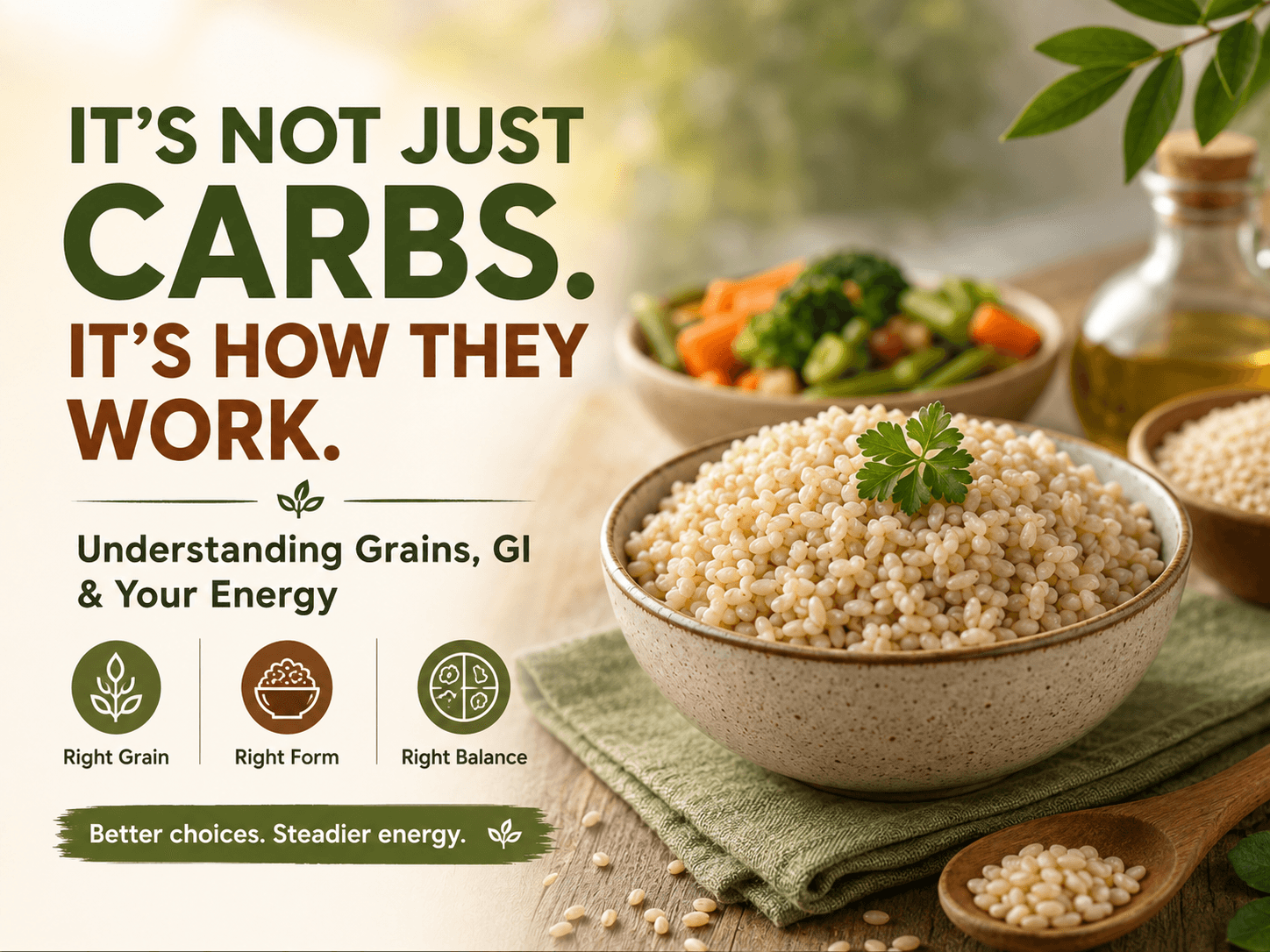
You eat a bowl of rice for lunch. You feel satisfied, get back to work-and a couple of hours later, you’re reaching for tea, coffee, or something sweet.
Sound familiar?
We often blame this on “not eating enough,” but sometimes the bigger question is: What kind of carbohydrate did you eat?
When it comes to grains, calories tell only part of the story. The type, structure, processing, fiber content and glycemic response of a grain can influence how quickly glucose enters your bloodstream-and consequently, how steady your energy feels.
It’s Not Just About the Calories
Two grain-based meals can have similar calories but create very different blood sugar responses.
This is where the Glycemic Index (GI) becomes useful. GI ranks carbohydrate-containing foods according to how quickly they raise blood glucose. High-GI foods are digested and absorbed more rapidly, while lower-GI foods generally produce a slower, more gradual rise.
But here’s the important part: GI is influenced by how the grain is processed.
A whole grain retains its bran, germ and endosperm. The bran provides fiber, while the intact grain structure can slow digestion. Refining and finely milling grains can remove much of this structure, making starch more accessible to digestive enzymes.
So, “carbohydrate” is not the whole story. The form in which you consume it matters too.
Why Fiber Changes the Energy Curve
Think of fiber as a speed regulator.
The fiber and structure of whole grains can slow the breakdown of starch into glucose. Instead of a rapid rise followed by a drop, glucose can enter the bloodstream more gradually.
That matters because a quick rise in blood glucose can be followed by a rapid fall, which may leave some people feeling hungry, tired or craving another quick source of energy.
This is one reason highly refined carbohydrates can provide short-lived energy, while higher-fiber carbohydrate sources can support a steadier release of fuel.
Whole Grain ≠ Automatically Low GI
This is where things get interesting.
Not every food labelled “whole grain” will have the same glycemic response. Particle size, cooking, processing and the overall meal composition can influence how quickly carbohydrate is digested. Finely ground grains, for example, are generally digested faster than more intact or coarsely processed grains.
So instead of asking:
“Are grains good or bad?”
A better question is:
“Which grain, in what form, and in what meal?”
What Does the Research Say?
The evidence increasingly supports choosing whole and minimally processed grains more often.
A 2024 systematic review and meta-analysis covering 10 prospective cohort studies and 37 randomized controlled trials found that higher whole-grain intake was associated with lower type 2 diabetes risk, while randomized trials showed reductions in fasting blood glucose, although effects on markers such as HbA1c were more modest.
Another meta-analysis of randomized controlled trials found that whole-grain consumption improved several measures of glucose metabolism in people with diabetes, including fasting glucose and HbA1c.
The takeaway isn't that one grain is a “superfood.”
It is that carbohydrate quality and grain structure deserve as much attention as calorie count.
The Grain on Your Plate Matters-But So Does the Plate
A grain rarely exists in isolation.
Rice with vegetables, dal, protein and healthy fats will create a different meal than a large bowl of refined rice eaten alone. Protein, fiber, fat and the overall composition of a meal can influence digestion and the resulting glucose response.
That’s why building a balanced plate is often more useful than completely eliminating carbohydrates.
The goal isn't fewer grains. It's smarter grains, better portions and better combinations.
The Bottom Line
Your body doesn't experience food as numbers on a calorie tracker.
It experiences starch, fiber, glucose, insulin, digestion and energy availability.
So when choosing your next grain, look beyond calories.
Choose grains that retain more of their natural structure, prioritize whole or minimally processed options, pay attention to portions, and pair carbohydrates with protein, fiber-rich vegetables and other nutrient-dense foods.
Because when it comes to energy, the question isn't simply how much you eat-it's how your body receives it.
GRAINLLY- Nature in Every Grain.