
The Smart Carb Revolution: Making Grains Work for Your Metabolism
20 Sept 2026 · Team Grainlly
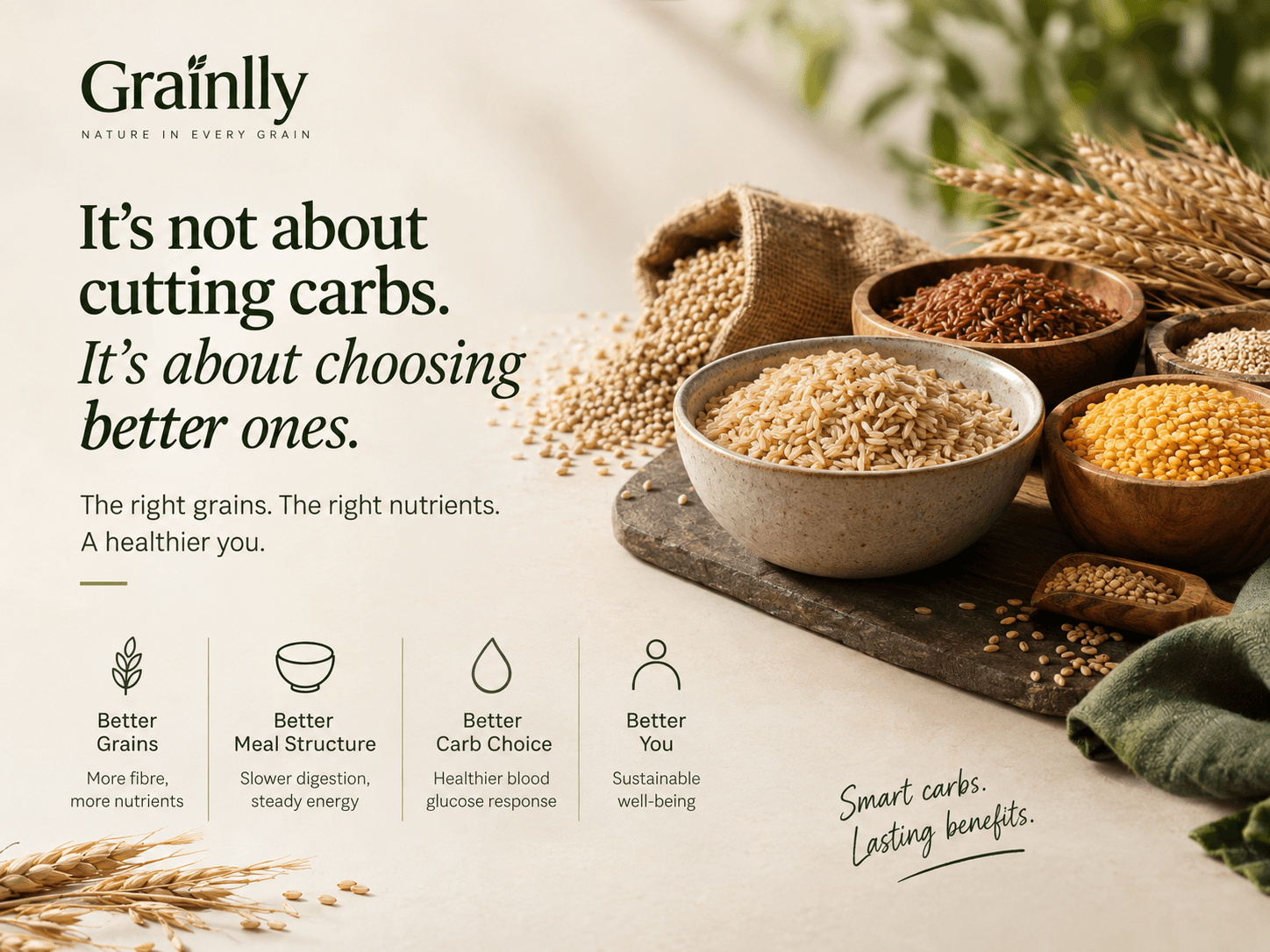
For years, carbohydrates have been given a bad reputation.
“Cut carbs to lose weight.”
“Rice makes you gain weight.”
“Carbs spike your sugar.”
But carbohydrates are not the problem. The type, quality, quantity and form of carbohydrate we choose can make a significant difference.
And that is where grains come in.
Not All Carbs Behave the Same
Your body doesn't respond to every carbohydrate in exactly the same way.
A highly refined grain can be digested and absorbed relatively quickly, while a less processed, fibre-rich grain may take longer to digest and can produce a more gradual rise in blood glucose.
This is one reason why the quality of the carbohydrate matters alongside the amount.
Research comparing whole-grain and refined-grain foods has found that whole grains can improve post-meal glucose and insulin responses, although the effects vary depending on the grain and the way it is processed.
Think Beyond “Low Carb”
Instead of asking:
“How can I eat fewer carbs?”
A better question is:
“How can I choose better carbohydrates?”
Whole grains retain components such as the bran, germ and endosperm, providing fibre and other nutrients that are reduced when grains are heavily refined.
Studies have found associations between whole-grain consumption and improved markers of glycemic control, including fasting glucose and HbA1c, although results are not identical across all studies or populations.
This makes the shift from low carb to smart carb a more meaningful conversation.
Where Does Low GI Fit In?
The Glycemic Index (GI) tells us how quickly a carbohydrate-containing food raises blood glucose compared with a reference food.
Low-GI foods generally produce a slower rise in blood glucose.
But here's the important part: GI isn't determined by the grain alone.
Variety, processing, particle size, cooking method, portion size and even the other foods in the meal can influence the final glycemic response.
Research on low-GI dietary patterns has shown benefits for blood glucose control in people with metabolic conditions, although the magnitude of benefit varies across studies.
So choosing a Low GI Grain can be useful-but it is only one part of making a smarter carbohydrate choice.
Your Metabolism Likes Structure
The way a grain is processed can influence how quickly its starch becomes available for digestion.
Less disrupted grain structures and higher fibre content can slow digestion and influence the post-meal glucose response.
And this matters because your metabolism isn't working in isolation.
Blood glucose, insulin, appetite, energy availability and overall dietary pattern are interconnected.
Recent evidence continues to support the role of whole grains as part of a dietary pattern that supports metabolic health, while also highlighting that effects differ depending on the grain, population and intervention.
So, What Is a “Smart Carb”?
A smart carbohydrate isn't necessarily the one with the fewest calories or the least amount of carbs.
It is one that offers nutritional value, appropriate processing, fibre and a favourable glycemic profile, while fitting into the overall meal and your individual needs.
Think:
Better grain → better meal structure → better carbohydrate choice.
And you don't necessarily need to eliminate rice, wheat or other traditional grains to eat well.
Sometimes, the smarter approach is simply to choose the right grain and use it well.
Making Grains Work For You
At Grainlly, we believe carbohydrates deserve a rethink.
The goal isn't to fear grains.
It's to understand them.
Because when you move from “carbs are bad” to “which carbs work better for me?”, you're no longer following a food trend.
You're making a more informed choice.
**The future of carbohydrates isn't about eating less.
It's about eating smarter.**
The scientific evidence supports the whole-grain/low-GI → glycemic control angle, but I’ve avoided making claims like “low GI automatically means weight loss” or “whole grains improve metabolism” as a blanket statement, because the research is more nuanced.