
What Makes a Grain “Good Quality”?
1 Sept 2026 · Team Grainlly
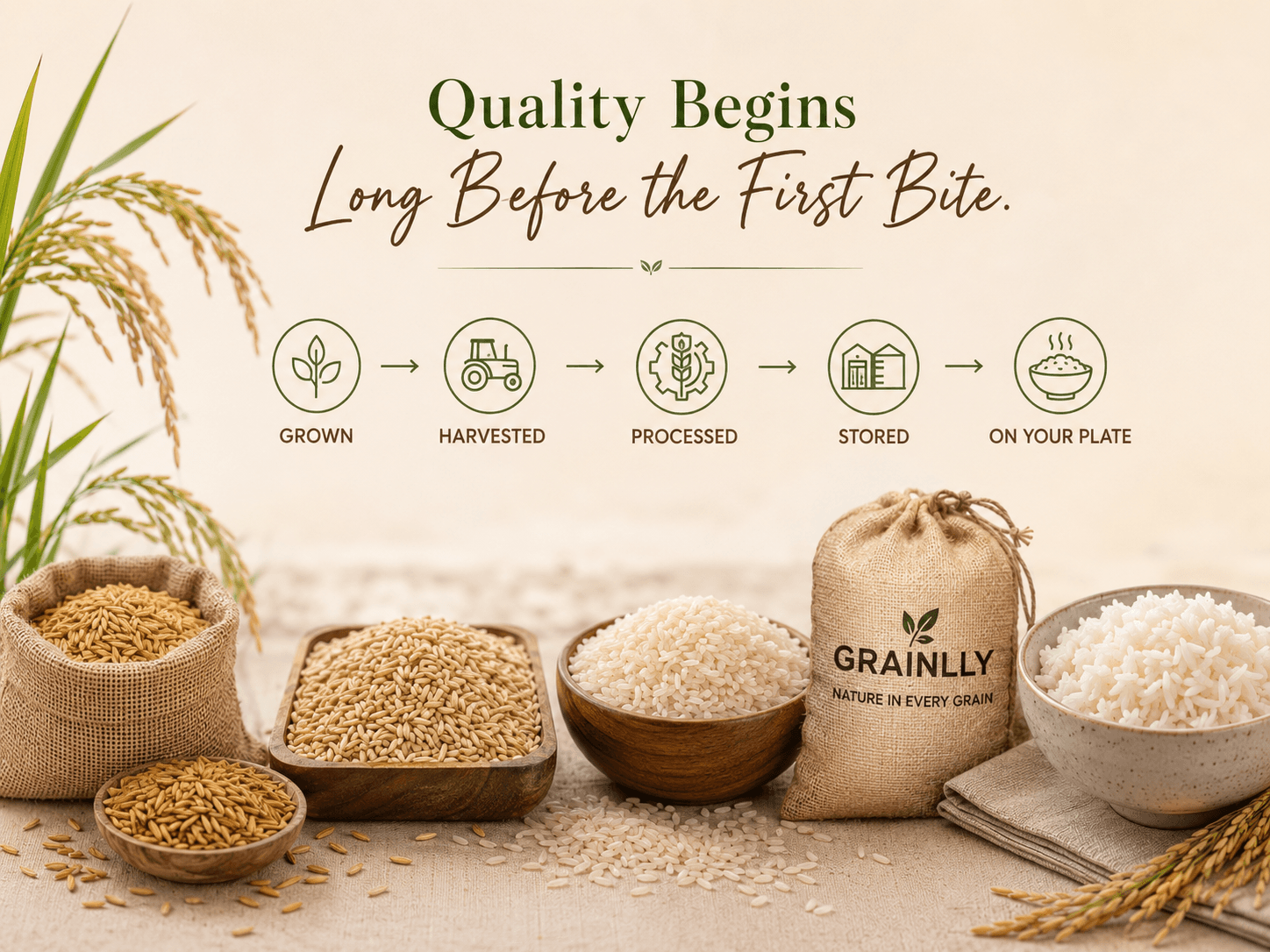
We often choose grains based on what we see-clean-looking grains, attractive packaging, or words like premium and natural.
But true grain quality goes much deeper.
It starts at the farm and continues through harvesting, processing, storage and finally, onto your plate.
Quality Starts Before the Grain Reaches Your Kitchen
A grain’s variety, growing conditions and farming practices can influence its nutritional composition, texture and cooking properties.
Even grains from the same category can differ. Research shows that the glycemic index of rice can vary depending on variety, processing and preparation.
So, “rice” or “wheat” alone doesn't tell us the complete story.
Whole Grain Does Not Automatically Mean Better Quality
Whole grains retain the bran, germ and endosperm, providing fiber, vitamins, minerals and other beneficial compounds.
However, being a whole grain is only one aspect of quality.
Proper sourcing, handling, processing and storage are equally important in determining whether a grain reaches you in its best condition.
Processing Matters More Than We Realize
How a grain is processed can affect how our body digests it.
Milling and grinding can change particle size and starch structure, which may influence the rate at which glucose enters the bloodstream. Research suggests that less-processed grain foods can produce a lower glycemic response than more finely processed forms.
This doesn't mean all processing is bad.
It means the degree and method of processing matter.
Good Quality Also Means Safe Quality
A grain can be nutritionally valuable, but it also needs to be safe.
Proper cleaning, drying and storage help protect grains from moisture, pests, fungal growth and contamination. Excess moisture during storage can increase the risk of spoilage and mycotoxin formation.
Because sometimes, what you cannot see matters just as much as what you can.
And Then Comes the Low GI Factor
When it comes to choosing better carbohydrates, Low GI Grains can be an important consideration.
The Glycemic Index (GI) indicates how quickly a carbohydrate-containing food raises blood glucose compared with a reference food.
But GI isn't determined by the grain alone. Variety, starch structure, processing, cooking method, portion size and the foods eaten alongside it can all influence the final blood glucose response.
This is why choosing quality, minimally processed and appropriate Low GI Grains can be a valuable part of a balanced diet.
But low GI alone doesn't define grain quality.
So, What Should We Look For?
A genuinely good-quality grain brings several things together:
Good variety.
Good sourcing.
Appropriate processing.
Safe storage.
Nutritional integrity.
And, where relevant, a favorable glycemic profile.
Quality is not just about how a grain looks in the packet.
It is about the entire journey-from farm to plate.
From Farm to Plate
At Grainlly, we believe better food choices begin with knowing what goes into the food on your plate.
Because a grain is more than just a source of carbohydrates.
It is the result of where it comes from, how it is handled, and how carefully its quality is preserved.
Quality begins long before the first bite.
GRAINLLY- Nature in Every Grain.